
OUR SERVICES
Understanding Functional Manual Therapy
A research-backed, hands-on system for getting to the root cause of pain.
Functional Manual Therapy® (FMT) was developed by Gregory S. Johnson, PT, and Vicky Saliba Johnson, PT. FMT is an integrated approach of evaluation and treatment that promotes optimum human performance by enhancing total body mobility and CoreFirst® postural and movement strategies.
Recent research and functional imaging of the brain continues to reveal the interrelationship between pain, muscular inhibition and poor movement strategies. Just mobilizing joints, giving patients stretching exercises, or having a patient participate in ‘core stabilization’ is not sufficient to address the complex interrelationship between mobility and motor strategies.
TREATMENT TECHNIQUES
Services & Specialties
A full toolbox of evidence-based, hands-on techniques tailored to your goals.
Manual Therapy
Hands-on mobilization and soft tissue work to restore movement and reduce pain.
Dry Needling
Solid filament needles used to treat neuromusculoskeletal issues locally, segmentally, and systemically.
Cupping Therapy
Decompression cups release fascial restrictions and improve tissue mobility.
Percussion Therapy
Targeted percussion to release tight muscles and improve circulation.
Gait Training
Retrain efficient walking and running mechanics for safer, pain-free movement.
Strength & Balance
Functional strength and balance work to rebuild stability and prevent re-injury.
IASTM Techniques
Instrument-assisted soft tissue mobilization to break down restrictions.
Kinesiology Taping
Therapeutic taping that supports joints without restricting movement.
Normatec Compression
Dynamic compression therapy that boosts recovery and reduces soreness.
Vestibular Rehab
Specialized therapy for vertigo, dizziness, and balance disorders.
12 AREAS OF FOCUS
Conditions We Treat

- Carpal Tunnel Syndrome
- Cubital Tunnel Syndrome
- De Quervain’s Tendinitis
- Elbow Bursitis
- Elbow Fracture
- Golfer’s Elbow (Medial Epicondylitis)
- Pitcher’s Elbow (Medial Apophysitis)
- Tennis Elbow (Lateral Epicondylitis)
- Thoracic Outlet Syndrome
- Ulnar Collateral Ligament (UCL) Injury
- Wrist Fracture
- Wrist Tendinitis
- Ankle Fracture
- Ankle Impingement
- Ankle Sprain
- Benign Hypermobility Joint Syndrome
- Peroneal Tendinopathy
- Tarsal Tunnel Syndrome
- Chronic Pain Syndrome
- Diabetes
- Fibromyalgia
- Lymphedema
- Osteoarthritis
- Pain
- Rheumatoid Arthritis
- Multiple Sclerosis
- Achilles Tendinopathy
- Bunion (Hallux Valgus)
- Cuboid Syndrome
- Lower Extremity Stress Fractures
- Peroneal Tendinopathy
- Planter Fasciitis
- Turf Toe
- Balance Problems
- Benign Paroxysmal Positional Vertigo (BPPV)
- Complex Regional Pain Syndrome
- Dizziness
- Falls
- Gait Dysfunctions
- Headaches & Migraines
- Parkinson Disease
- Stroke
- Temporomandibular Joint Disorder
- Traumatic Brain Injury
- Vertigo
- Benign Hypermobility Joint Syndrome
- Femur Fracture
- Greater Trochanteric Bursitis
- Groin Strain
- Hamstring Injuries
- Hip Bursitis
- Hip Impingement (Femoroacetabular Impingement)
- Hip Labral Tear
- Iliotibial Band Syndrome (ITBS or IT Band Syndrome)
- Osteoarthritis of the Hip
- Pelvic Fracture
- Pelvic Pain
- Snapping Hip Syndrome
- Total Hip Replacement (Arthroplasty)
- Above-Knee Amputation (Transfemoral Amputation)
- Anterior Cruciate Ligament (ACL) Tear
- Below-Knee Amputation (Transtibial Amputation)
- Knee Bursitis
- Knee Pain
- Medial Collateral Ligament (MCL) Injury
- Medial Patellofemoral Ligament (MPFL) Injury
- Meniscal Tear
- Osgood-Schlatter Disease
- Osteoarthritis of the Knee
- Patellar Instability
- Patellofemoral Pain
- Pes Anserine Bursitis
- Plica Syndrome
- Posterior Cruciate Ligament Injury
- Total Knee Replacement (Arthroplasty)
- Above-Knee Amputation (Transfemoral Amputation)
- Below-Knee Amputation (Transtibial Amputation)
- Calf Strain
- Lower Extremity Stress Fractures
- Phantom Limb Pain
- Shin Splints (Medial Tibial Stress Syndrome)
- Cervical Radiculopathy
- Degenerative Disk Disease
- Herniated Disk
- Neck Pain
- Osteoarthritis of the Spine
- Thoracic Outlet Syndrome
- Torticollis
- Above-Knee Amputation (Transfemoral Amputation)
- Femur Fracture
- Groin Strain
- Hamstring Injuries
- Iliotibial Band Syndrome (ITBS or IT Band Syndrome)
- Acromioclavicular Joint Injuries
- Ankylosing Spondylitis
- Benign Hypermobility Joint Syndrome
- Biceps Tendinitis
- Biceps Tendon Rupture
- Collarbone Fracture
- Frozen Shoulder
- Osteoarthritis of the Shoulder
- Proximal Humeral Epiphysitis
- Proximal Humerus Fractures
- Rotator Cuff Tear
- Rotator Cuff Tendinitis
- Shoulder Bursitis
- Shoulder Dislocation
- Shoulder Impingement
- Shoulder Labral Tear
- Shoulder Replacement (Arthroplasty)
- Snapping Scapula Syndrome
- Ankylosing Spondylitis
- Degenerative Disc Disease
- Herniated Disk
- Hyperkyphosis
- Low Back Pain
- Lumbar Radiculopathy and Sciatica
- Osteoarthritis of the Spine
- Scoliosis
- Spina Bifida
- Spinal Compression Fractures
- Spinal Muscular Atrophy
- Spinal Stenosis
- Spondylolysis and Spondylolisthesis
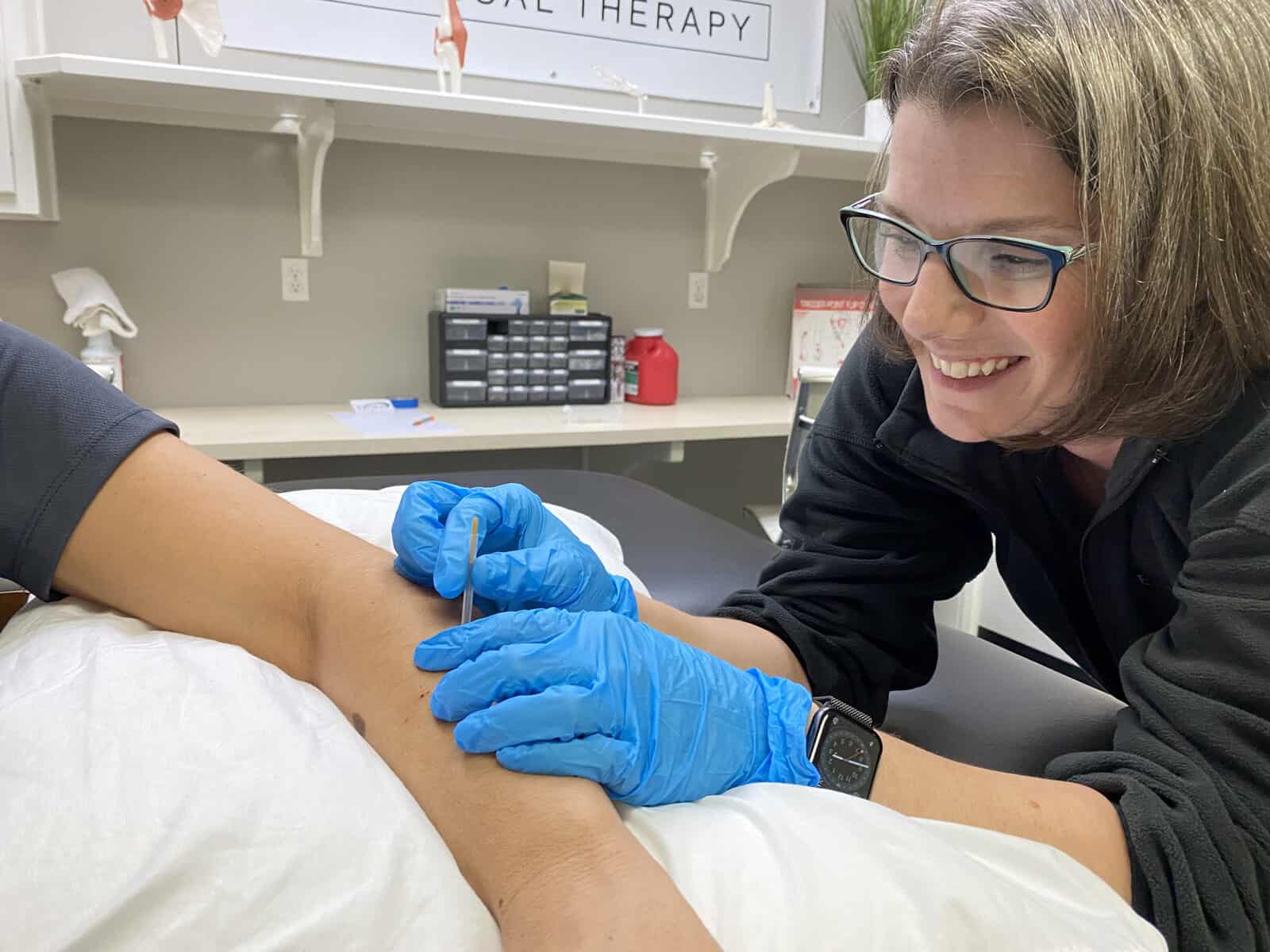
SPECIALIZED TECHNIQUE
What is Integrative Dry Needling
Neurologic Dry Needling (NDN) is the evolution from needling points (myofascial trigger points) to needling the system. NDN is utilized to treat all types of neuromusculoskeletal conditions. These conditions are not limited to orthopedics but are applicable to any condition where inflammation (neurogenic), reduced blood flow and muscle guarding is present. The NDN treatment system is based on peripheral and central neurologic principles, which is not limited by the traditional trigger point paradigm. Using the peripheral nerve mapping model allows a broader opportunity to deliver treatment locally, segmentally, and most importantly systemically.
How does it work?
Studies suggest that inserting a needle into trigger points can cause favorable biochemical changes which assist in reducing pain. Eliciting a Local Twitch Response — a spinal cord reflex — is the first step in breaking the pain cycle.